


In 2026, AI is accellerating development, and the average cost of developing a consumer app in the UK has dropped from £300,000 to £150,000. This article gives you a breakdown of where the costs are when taking your first app to market, and more importantly sustaining ongoing app development. For context, I'm assuming you're a UK funded startup, scaleup or established organisation outsourcing to a mid-sized UK app development agency.
I know what you're thinking, £150,000 is a lot of money. That's because we need to consider two things:
- The total cost of ownership: What is the entire journey to take a successful app to market?
- Talent cost: What is the geography and experience levels of the poeple buliding your app?
Let's start with the journey.
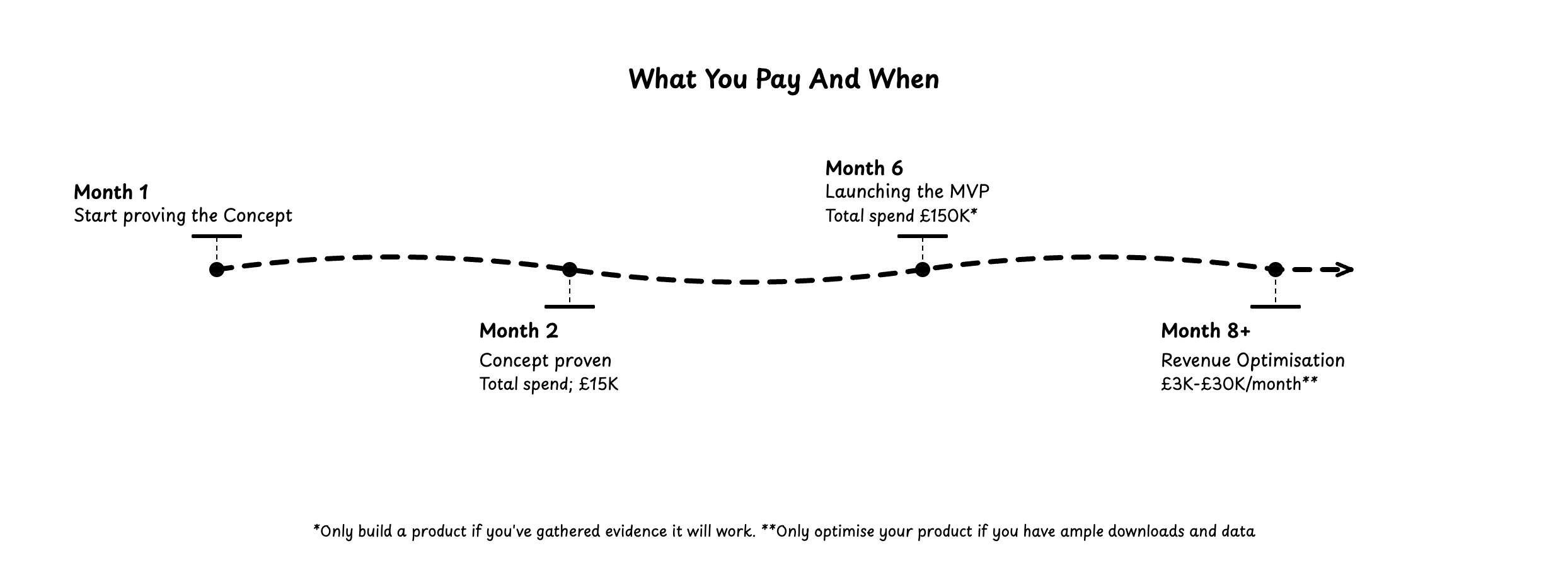
The cost of the app development journey
1. Proof of concept for laser focus: £5K-£25K - Create a small prototype to prove you're idea will work. It's more expensive if there there are more unknowns. For example, we recently workied with a connected devices manufacturer who had a lot of ideas, and wanted to learn which ones resonated most with their audience. So the proof of concept phase includes the user research that helps them get laser focused on what to build, and what not to build.
2. Minimal Viable Product: £60K-£250K - This is about launching a high quality app with just enough features to give your customers some real value. Of course, it's informed by the proof of concept.
3. Ongoing Optimisation: £20K-£100K - Just as a supermarket will optimise their store layout to increase sales, your MVP should be optimised to increase conversion rates and revenue. This means observing what customers do, where they struggle, or even abandon ship. Then, finding the root cuase and fixing it.
Here's an example of that on a timeline.
So, what about the talent costs?
At a minimum, you usually need a few roles to developer a successful app.
- App Developer
- Designers with mobile UX skills
- Testers
- Backend Developer
- Product Owner (gluing it all together)
- You might get one person that can do all of some of here roles.
In the UK, it can easily cost £400-600 a day for a freelancer or contractor. Or, £650-£1200 for an agency like Pocketworks. Fun fact, the BenchPress 2026 report showed that the average hourly rate for a UK agency is £122, so that's just short of £1,000 a day.
Returning to our example, if your app needs 5 days of UX and 15 days of AI-assisted dev, and a day or two of testing. That’s 22 days at 500 a day average - £11k. Using cheaper labour might halve that.
The thing is, we manage apps that do £2m-£100m+ revenue, and we often spend £10k-£20k on a single feature, sometimes more.
That's because we need to get them right in order to get the return. Sometimes they need developing a few times becuase an idea seemed good in design but actually didn't play out well once delivered. Sometimes we need to run a survey to understand user needs better, or interview users to find out what's most important to them. Sometimes we hit a quality or speed problem on low-end Android devices that aren’t issues on iOS. Those need extra work to iron out. Sometimes we'd launch a feature and realise users bounce away from it, so we need to learn why and fix it.
All this adds up, and that’s why multi-million revenue apps cost money, even if you have cheap labour.
In summary, a mature app development process involves mulitple lifecycle stages from proof of concept to minimal viable product to ongoing improvements. It also requires a mix of skillsets, and experienced people tend to be expensive. You can save money by going offshore to geographies with lower living costs, but that can bring additional problems around communication and legal protection.
Now, let's dive into the cost of a proof of concept, the first part of the app development journey.
How much does a proof of concept cost?
First, let's break "validated proof of concept" down.
- The Concept: The concept is a cheap sketch, prototype or some other artefact that helps you reduce risk in some way. For example, if you're not sure the tech will work, you could test that with a small sample app. Or if you need to check customers will buy your product, you could get some customer feedback from a survey or focus group. You might have even used AI to generate some ideas yourself, and those are a great proof of concept.
- The Proof: There's no point building that concept if you don't take the time to then prove anything with it. What do I mean by this? Let's say you vibe-code an idea on Lovable. To prove it, you would then show it to 15 people in an unbiased user test. Youm may learn that three of your features really solved a problem for your audience, but two of them were undesirable by the majority. Or perhaps one feature made no sense and confused people. Therefore, you have proved your concept, learned a boat load about your solution, and also where to focus your budget when buliding an MVP (the next stage).
To give some ideas based on our 2026 data, developing the concept can be anywhere from £2K-£15K, and gathering the proof can also be anywhere from £2K-£15K. So it's typically a £4K-£30K exercise. Here are a few concrete examples, using different validation techniques.
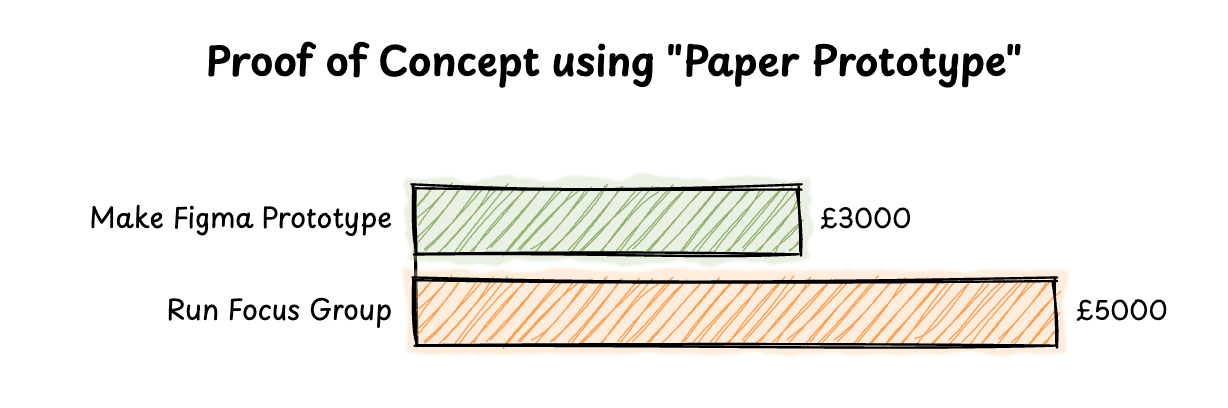
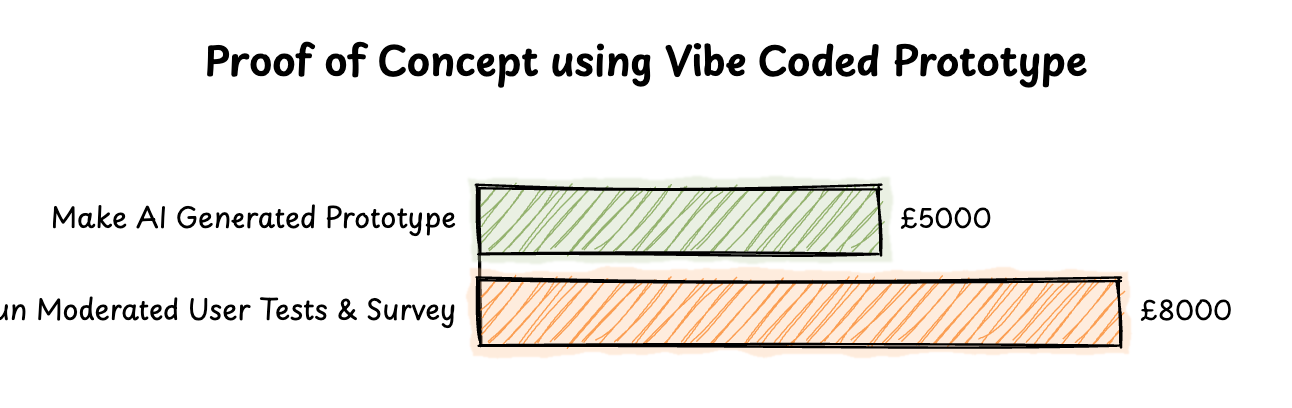
Note, if you want the Pocketworks team to look at your project, see our end-to-end four-week proof of concept service, and also our standalone idea validation services.
Next, let's look at the MVP costs - where you actually launch a product in the wild that could generate revenue with a loyal customer base.
How much does an MVP cost?
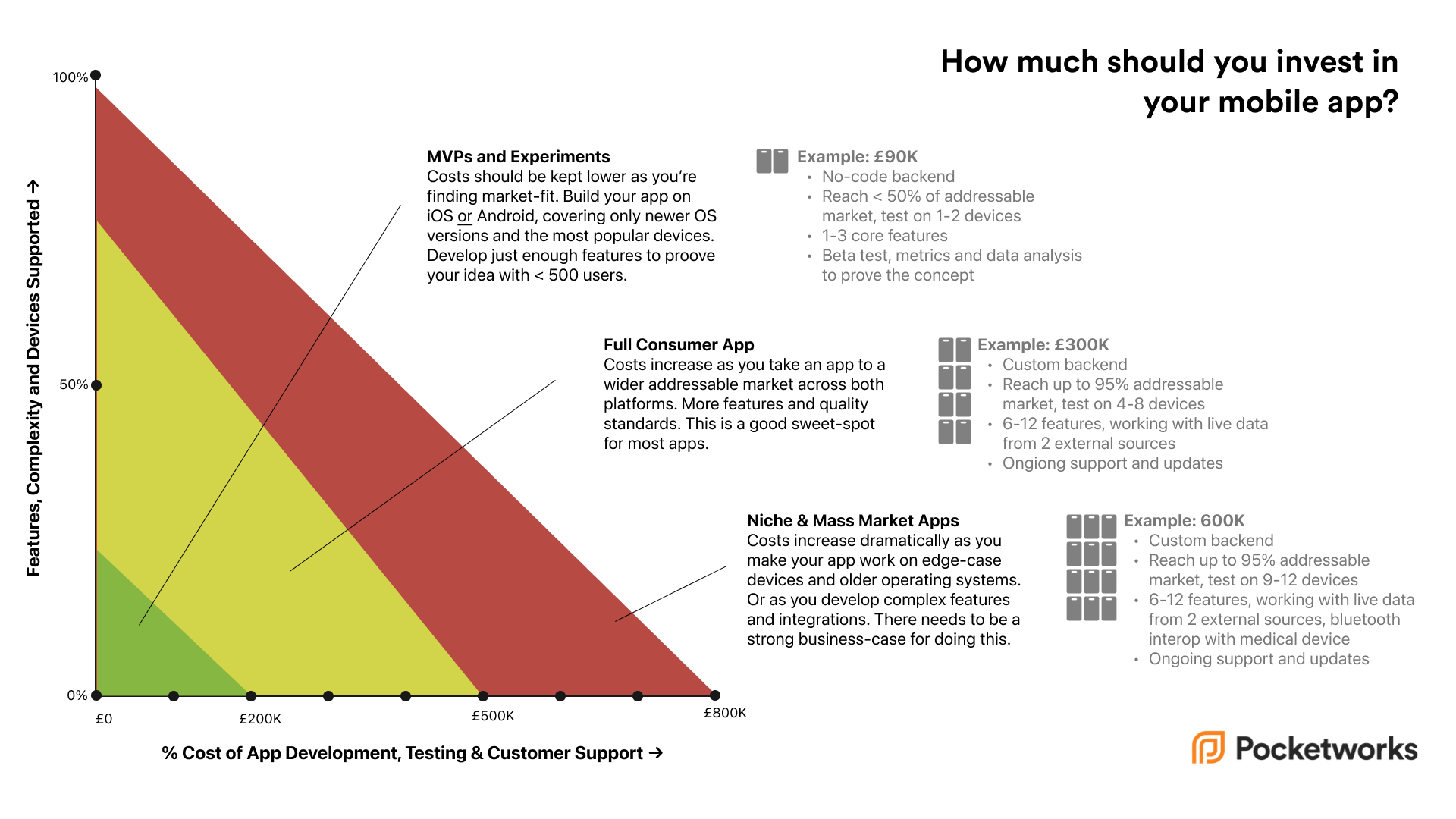
After the low-cost proof of concept, companies often develop a minimal version of their app ideas for £80K-£250K. The goal is to get a first version out there to start delivering value to customers and potentially generating revenue.
That's a big number, rightI? Especially when AI is allowing a team of there digital product developers to act like a team of nine. However, it's easy to miss the hidden app development costs, and focus purely on build. More about those in Badly Drawn Mobile - a visual guide for business leaders. For now, let's just say that you may have costs associated with device fragmentation, mobile testing, API and platform development, ASO, design systems and accessibility. As an example, here's a quick chart showing the breakdown of a £175K budget over 12 months.
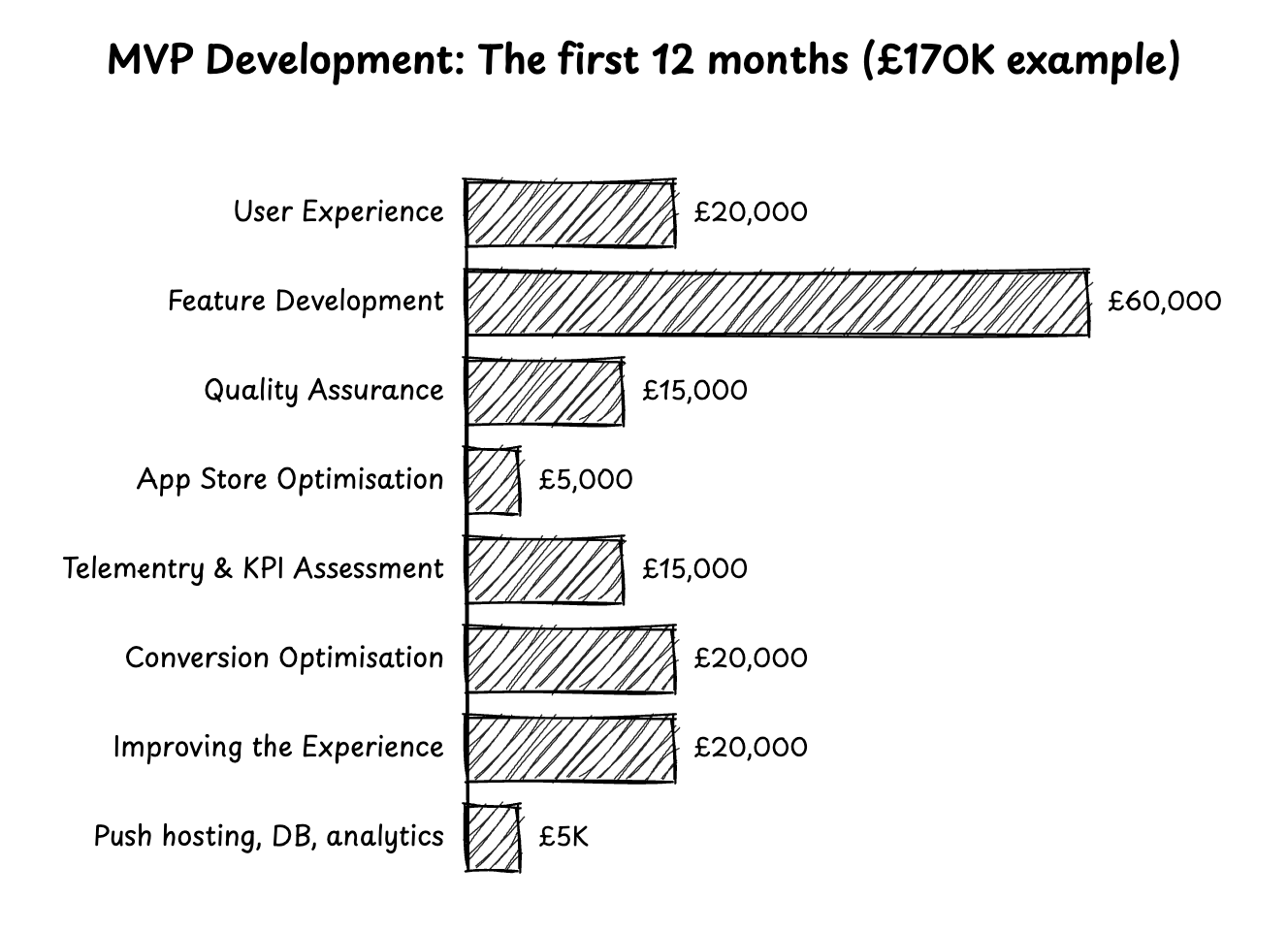
As you can see, there's a fair bit that goes into it.
Note that, when talking about an MVP, I generally refer to the original definition which is a proper product that can generate revenue. This is slighly differnt to the definition in the Lean Startup book. Learn more about the difference between an MVP and full product development.
Typically, launching an MVP is going to open up a whole world of possibilities. Assuming you a way to get downloads, you'll now want to tune the hell out of it to drive up revenue. Let's look at that next.



 2025 Pocketworks Mobile Ltd